Mental health in the workplace: change the work first, then add programs
Employers can support mental health at work by changing the work that strains people first, then adding managers' practice, programs and sessions. The law asks for some of it, and varies by province.
OHA Team, OHA Wellness
Published · Updated · Practice · 6 min
The short answer
Employers can support mental health in the workplace by changing the work first (workload, recovery, decisions), then managers' practice, then programs such as the EAP, then sessions.
On this page
- How can employers support mental health in the workplace?
- How big is the impact of mental health on Canadian workplaces?
- What do employers owe employees on mental health?
- Where do programs, the EAP and sessions fit?
- Where do you start in 30 days?
- What should employers not do?
- What OHA does about this
- Sources
Employers can support mental health in the workplace by changing the work that strains people first, then adding programs and sessions around it. Four of the World Health Organization's (WHO) recommendations are: organizational interventions that assess, then mitigate, modify or remove workplace risks; manager training; training for workers; and interventions that help individuals build skills to manage stress.
In Canada the impact and the legal duties are both concrete. This guide covers the impact, what employers owe in Ontario, in Quebec and in federally regulated workplaces, what helps in what order, and where to start in 30 days. It is information, not legal advice: for a case, ask an employment lawyer or the regulator.
How can employers support mental health in the workplace?
Work in this order: the design of the work, manager practice, programs and the EAP, then sessions. Work design comes first because it decides how much load people carry. WHO lists excessive workloads or work pace and understaffing among the risks to mental health at work, next to violence, harassment or bullying and discrimination and exclusion.
Manager practice comes second because managers are where those risks become daily decisions: who covers what, how a hard conversation goes, whether a deadline moves. Programs and the EAP come third and give individuals somewhere to go. Sessions come fourth and give a team a shared pause. Each layer helps; none replaces the one before it.
How big is the impact of mental health on Canadian workplaces?
Large enough to show up in surveys, claims and budgets. In Statistics Canada's April 2023 survey of employed people aged 15 to 69, 21.2% reported high or very high work-related stress, and a heavy workload was the cause named most often, by 23.7%. A report by CSA Group, summarized by the Institute for Work & Health in June 2026, estimates that poor mental health costs Canada's economy about CAD 180 billion a year, of which CAD 106 billion falls mainly on employers through disability claims, insurance premiums, group benefits, accommodations and related costs. Worldwide, WHO estimates that 12 billion working days are lost every year to depression and anxiety, at a cost of US$1 trillion in lost productivity. For more Canadian figures with their sources, see the workplace mental health statistics for Canada.
What do employers owe employees on mental health?
The duties depend on where the workplace sits, and this is a summary, not advice. In Ontario, the Human Rights Code prohibits discrimination based on disability, which includes mental health disabilities and addictions, and employers must offer accommodations unless doing so would cause undue hardship. The Occupational Health and Safety Act requires employers to have workplace violence and workplace harassment policies and programs and to inform workers about them. Ontario's guide to the Act says the policies must be prepared and reviewed at least annually (section 32.0.1), and that an investigation appropriate in the circumstances must follow incidents and complaints (section 32.0.7). Our post on the OHSA and psychological health for Ontario managers goes further.
In Quebec, the CNESST says employers of establishments with 20 or more workers must draw up, apply and update a prevention program every year. The CNESST's description of the program's content says it must identify and analyze risks, including psychosocial risks, and that the harassment prevention policy is part of it.
For employers in a federally regulated industry or workplace, the Canada Labour Code's harassment and violence prevention requirements have applied since 1 January 2021. They include a prevention policy developed with the applicable committee or representative, a risk assessment, training for everyone in the workplace, a resolution process and an annual report to the Labour Program by 1 March. Where a law is unclear for your workplace, ask an employment lawyer, the CNESST or the Labour Program.
Five Loads quick check · 1 minute
Find the load consuming your team's capacity.
Five statements, about a minute. See all five loads side by side. Before you plan a program, look at the load. Answer for your own week or your team's: how often is each of these true?
Statement 1 of 5
Where do programs, the EAP and sessions fit?
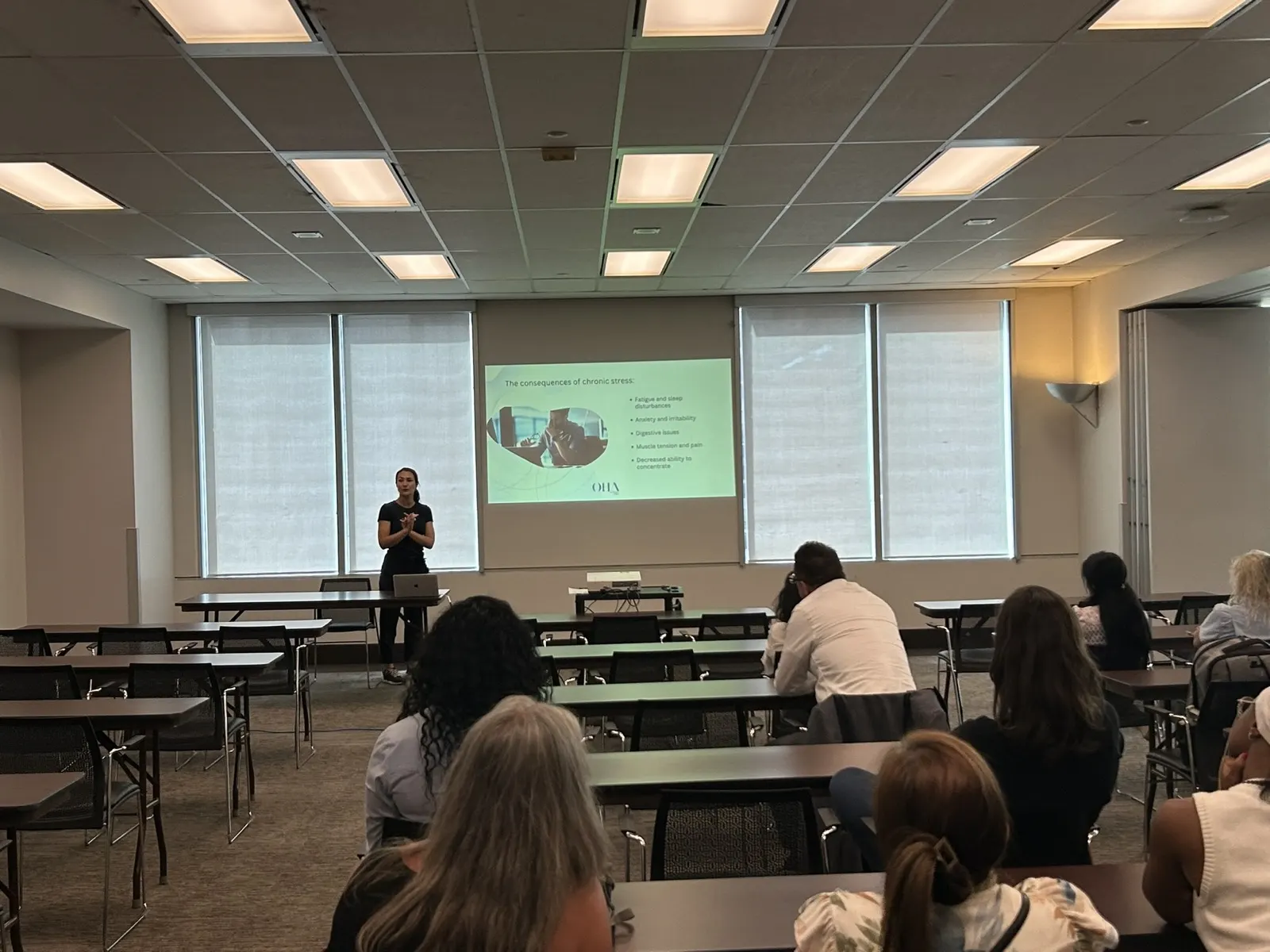
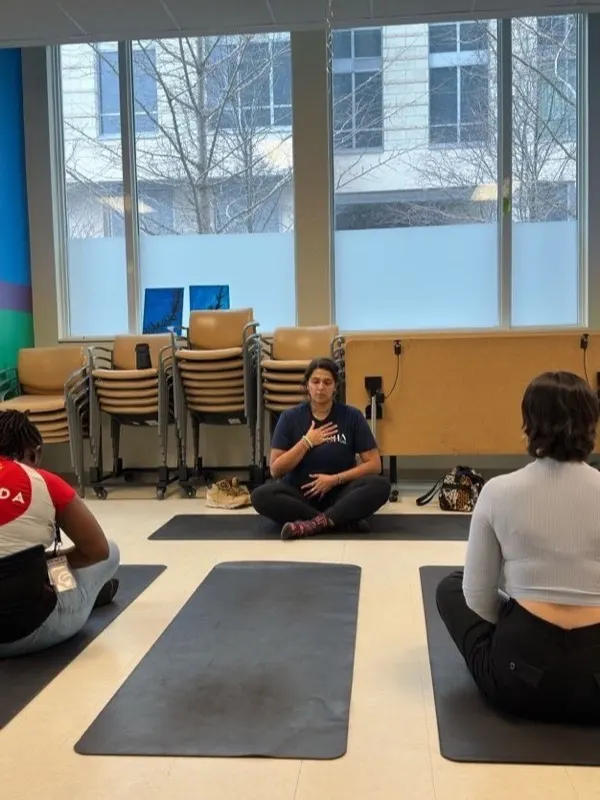
They sit on top of the work, not in place of it. The EAP and benefits are the standing supports; our guide to mental wellness programs beyond the EAP looks at what each covers. Sessions such as breathing practices or workshops are the door in: OHA's page on an employee wellness program in Toronto describes a monthly or quarterly series led in your office, in English or French.
For a framework outside any vendor, the Mental Health Commission of Canada describes its National Standard of Canada for Psychological Health and Safety in the Workplace, launched in January 2013, as a set of voluntary guidelines and practical resources. Our post on where to start with psychological health and safety turns it into a first sequence.
Where do you start in 30 days?
Measure, pick one load, brief the managers and set the date to measure again. In the first week, find out where load sits in one team: the quick check above is one way, and a Capacity Diagnostic across the team is another. In the second, pick the one of the Five Loads that weighs most. In the third and fourth, agree one change with that team's managers, such as one approval removed or one recurring meeting dropped, and book the second measure for day 90.
One team and one change is enough. It gives you a before and an after, and it shows managers that raising a load leads to something being done about it.
What should employers not do?
Do not run a wellness week and leave the work unchanged. A week of sessions with the same workload, the same approvals and the same unanswered questions tells people the problem is theirs to manage.
Do not ask individuals to disclose a diagnosis as a way to get help, and do not treat a program's attendance as proof that anything changed. Ask what changed in the work, and measure the same thing twice.
What OHA does about this
OHA treats mental health at work as a question of load before it is a question of programs. A Capacity Diagnostic is built to measure the Five Loads across a team, and 90-day cycles are designed to help leaders act on the load that weighs most, then measure again at day 90. Sessions can be the first step, led in your own office. Send OHA the team you would start with and the load you suspect, and ask for a quote within one business day. See how sustainable human performance works.
Sources
- World Health Organization, Mental health at work, fact sheet, 15 September 2026.
- Statistics Canada, Work-related stress most often caused by heavy workloads and work-life balance, 19 June 2023 (April 2023 data).
- Institute for Work & Health, Mental health challenges cost employers over $100 billion a year, June 2026.
- Government of Ontario, Mental health in the workplace, Page consulted 12 November 2026.
- Government of Ontario, Understand the law on workplace violence and harassment, Page consulted 12 November 2026 (guide to the OHSA, sections 32.0.1 and 32.0.7).
- CNESST, Programme de prévention d'établissement, Page consulted 12 November 2026 (in French).
- CNESST, Contenu du programme de prévention, Page consulted 12 November 2026 (in French).
- Government of Canada, Requirements for employers to prevent harassment and violence in federally..., 30 December 2025 (date from the page details).
- Mental Health Commission of Canada, Workplace Standard, 2013 (launched January 2013).