
Workplace wellbeing or capacity: which should you measure?
Workplace wellbeing tells you how people are doing; capacity tells you what their work is asking of them. If you can measure only one to decide what to change, measure capacity.
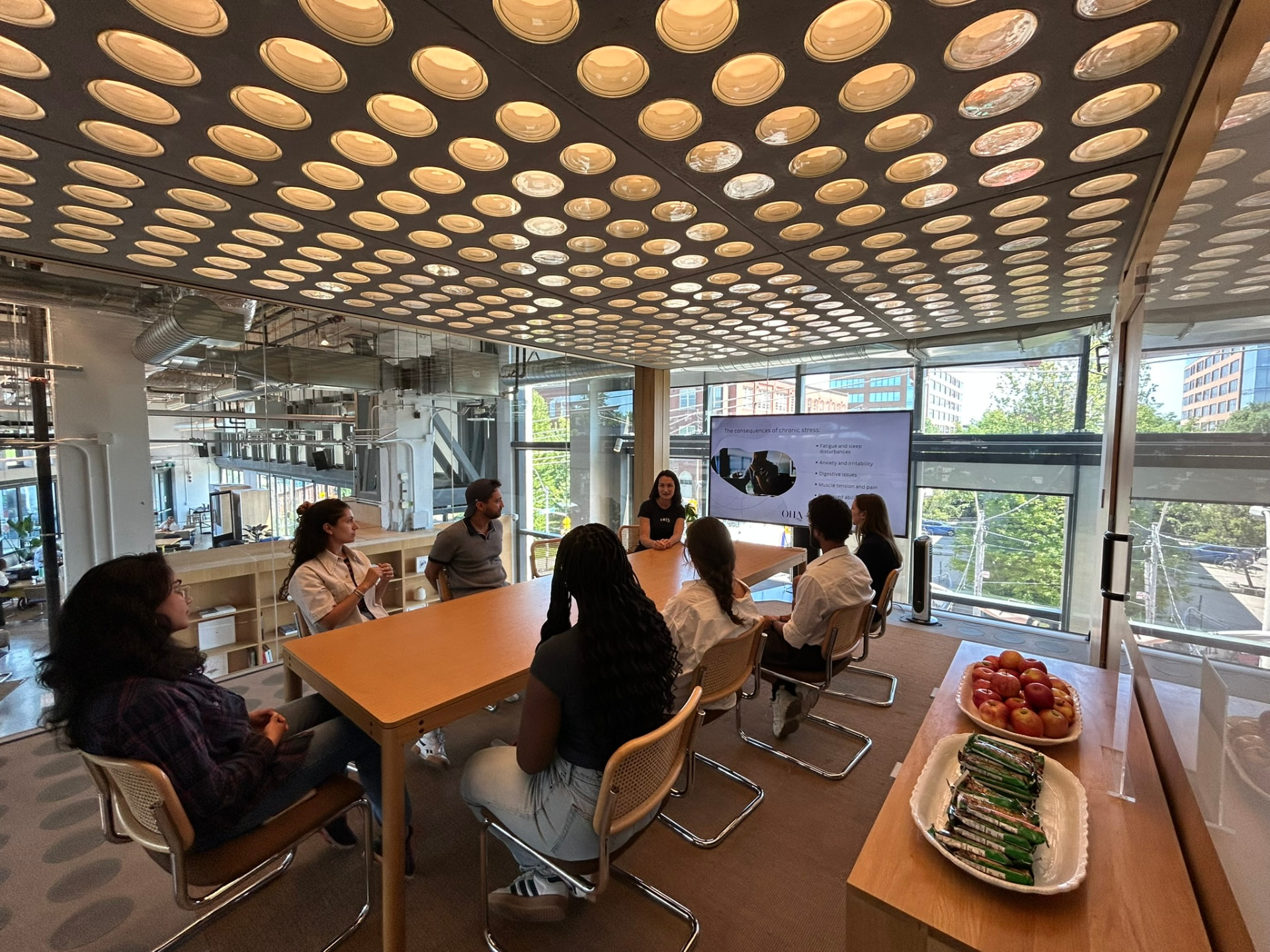
Workplace wellbeing is worth tracking, but if you can measure only one thing to decide what to change, measure capacity. Wellbeing tells you how people are doing; capacity tells you what their work is asking of them, and the work is the part an employer can redesign.
That is OHA's position. Capacity is OHA's own framework and is described here as such; the outside sources cited below are about working conditions, which is where an organization has leverage. The aim is to help you choose what to read first, because what you read first decides what you fix.
What is the difference between workplace wellbeing and capacity?
Workplace wellbeing describes a state: how people feel, how they rate their lives and whether they use the supports on offer. Capacity, in OHA's framework, describes a relationship: what the work demands of a person, set against what they have to meet it.
Gallup's State of the Global Workplace 2026 report is a good example of the first kind of reading. It finds that global employee engagement fell to 20% in 2025, its lowest level since 2020, and that the share of employees Gallup classes as thriving stood at 34%, up from 24% when Gallup first measured it in 2009.
Numbers like these tell you how people are. They do not tell you which part of a job is heavy, or why. OHA's Five Loads framework asks that second question by separating demand into decisional, cognitive, emotional, relational and administrative load, because each one calls for a different change.
Why is a wellbeing program not enough on its own?
Because a wellbeing program sits beside the work, not inside it. The Canadian Centre for Occupational Health and Safety (CCOHS) describes workplace health promotion programs, also called well-being or wellness programs, as a proactive approach to healthy living for all employees, and notes that, unlike health and safety programs, participation must always be completely voluntary.
That has a consequence for measurement. Take-up tells you who chose to attend; it cannot tell you what the job asks of the people who did not. The CCOHS places the work itself in a different part of its framework, the psychosocial work environment, which covers organizational culture and the organization of work, including demands or workload, control over how work is done and clarity of roles.
The CCOHS also warns that a negative culture can undermine the effectiveness of the best programs, policies and services meant to support the workforce. A well-run program inside a job that stays heavy is working against the current.
What can an organization actually change?
Working conditions. The World Health Organization (WHO) says preventing work-related mental health conditions is about managing psychosocial risks, and recommends that employers do it through organizational interventions that directly target working conditions and environments: assess a risk, then mitigate, modify or remove it.
WHO says risks to mental health at work may be related to job content or work schedule, specific characteristics of the workplace or opportunities for career development. The CCOHS adds that workload is not only the amount of work; it is also whether people have the resources, meaning time, equipment and support, to do the work well.
WHO also says that protecting and promoting mental health at work is about strengthening the capacities of people who supervise others, such as managers, to recognize and act on mental health conditions at work. That matters, and it works better when the organization has first shown its managers where demand sits and given them something in the work they are able to change.
That second point is the bridge to capacity. Demand set against the resources to meet it is the question OHA's framework asks, across five kinds of demand rather than one. Measuring it shows where demand has concentrated, and that is something a manager or an HR lead can move.
Should you measure both?
Yes, when each is asked to do its own job. Read wellbeing to learn how people are doing and whether supports are reaching them; read capacity to learn where the work is heavy and which change to make first.
The CCOHS notes that organizations will most likely need more than one assessment method, and lists several: internal data such as complaint reports, absenteeism and turnover rates, an audit of policies and management practices, and feedback gathered through conversations, observation, group discussions and surveys. A wellbeing reading and a capacity reading are two more lenses that can sit side by side.
Order matters. Reading capacity first shows you where to act, and reading both again after the change shows whether it worked. OHA's Capacity Circle™ is built that way: measure, act on one load for 90 days, then measure again with the same instrument.
What should you decide before you choose?
Decide which decision the measure is for. If the decision is whether a support is reaching people, wellbeing and take-up data answer it. If the decision is where work is too heavy and what to change, a capacity reading answers it, and it is the one that points at something you can redesign.
Then name an owner and a date. A reading that nobody owns becomes a slide; one with an owner and a 90-day return date becomes a change. For the executive who signs the budget, the practical test is simple: after the next measurement, can someone point to one thing in the work that is different?
For the longer argument on how a capacity reading differs from an engagement survey, see our post on what a capacity diagnostic actually measures. For the idea of human capacity at work in general, start with sustainable human performance.
What OHA does about this
OHA's Capacity Diagnostic is designed to measure the Five Loads across your teams, show which one dominates in each function, and set the baseline for a 90-day Capacity Circle™ built around that load, with the same measurement repeated at day 90. The wellbeing indicators you already track can sit beside it. The work that follows is built around what the measurement names, not a generic program. Book a Capacity Diagnostic to see what you would receive.
Book a Capacity DiagnosticSources
- Gallup, State of the Global Workplace: 2026 Report, 2026 (2025 data).
- CCOHS, Workplace Health and Well-being (OSH Answers), 28 February 2022 (page last revised).
- CCOHS, Mental Health - Psychosocial Risk Factors in the Workplace, 18 September 2023 (page last revised).
- World Health Organization, Mental health at work (fact sheet), 15 September 2026.
- CCOHS, Assessing Psychosocial Hazards (OSH Answers), 27 April 2022 (page last revised).