Corporate team building activities nobody dreads
The best corporate team building activities are shared, held in work time and open to everyone. Twelve ideas sorted by time, and how to tell whether one worked.
OHA Team, OHA Wellness
Published · Updated · Practice · 6 min
The short answer
Pick an activity everyone can take part in, held in work time, with no competition or performance, and leave room for a real conversation afterwards. A 2009 meta-analysis found a positive, moderate effect of team building on team outcomes.
On this page
The best corporate team building activities are shared, held in work time and open to everyone, with no one asked to perform. They build a team because they give people a moment in common and a real conversation afterwards, not because they are fun.
This post is for whoever has to plan the activity: HR, an office manager, a team lead. It covers why so many fail, twelve corporate team building ideas sorted by time, when to hold one and how to tell whether it worked. Shared wellness sessions sit next to other formats, including indoor ones that need no travel.
Why do most corporate team building activities miss?
Because they ask people to play a part in front of colleagues instead of sharing something with them. Forced fun, competition that pits sub-groups against each other, evening events, physical tests not everyone can take and alcohol that turns the event into a sociability test all have the same effect: some join out of duty, others opt out, and the team leaves more divided than it arrived.
The activities that do bring people closer share five traits. They are shared: everyone has the same experience at the same time. They are accessible: nobody needs fitness, talent or a particular taste. They happen in work time, so nobody pays for them with an evening or family duties. They are short, since one well-run hour beats a day endured. And they lead into a real conversation about the work, even ten minutes of it.
That last trait is the one most often dropped. An activity that ends with everyone drifting back to their desks leaves little behind; one that ends with "what do we keep for next week?" leaves more.
Why run a team building activity at all?
To give a team a shared experience that makes everyday collaboration easier. A 2009 meta-analysis by Klein and colleagues in Small Group Research pooled 60 correlations from team building studies and found a positive, moderate effect on team outcomes overall.
The effect is not automatic: it depends on what is done and how. A team whose members know each other through email and twenty-minute meetings gains familiarity first: you learn how the other person reacts, what makes them laugh, what they worry about. That familiarity makes ordinary disagreements cheaper.
An activity does not replace what weighs on the team day to day. If people are short of time because approvals pile up or priorities change every week, a half day of relaxing fixes nothing. It works better when it sits alongside work on the load itself.
Five Loads quick check · 1 minute
Find the load consuming your team's capacity.
Five statements, about a minute. See all five loads side by side. Before you choose, answer for your own week, or for your team: how often is each of these true?
Statement 1 of 5
What are good corporate team building ideas?
The ones that fit the time you have and meet the same five tests: shared, accessible, in work time, short, followed by a conversation. These twelve corporate team building ideas are sorted by time, and you can mix them.
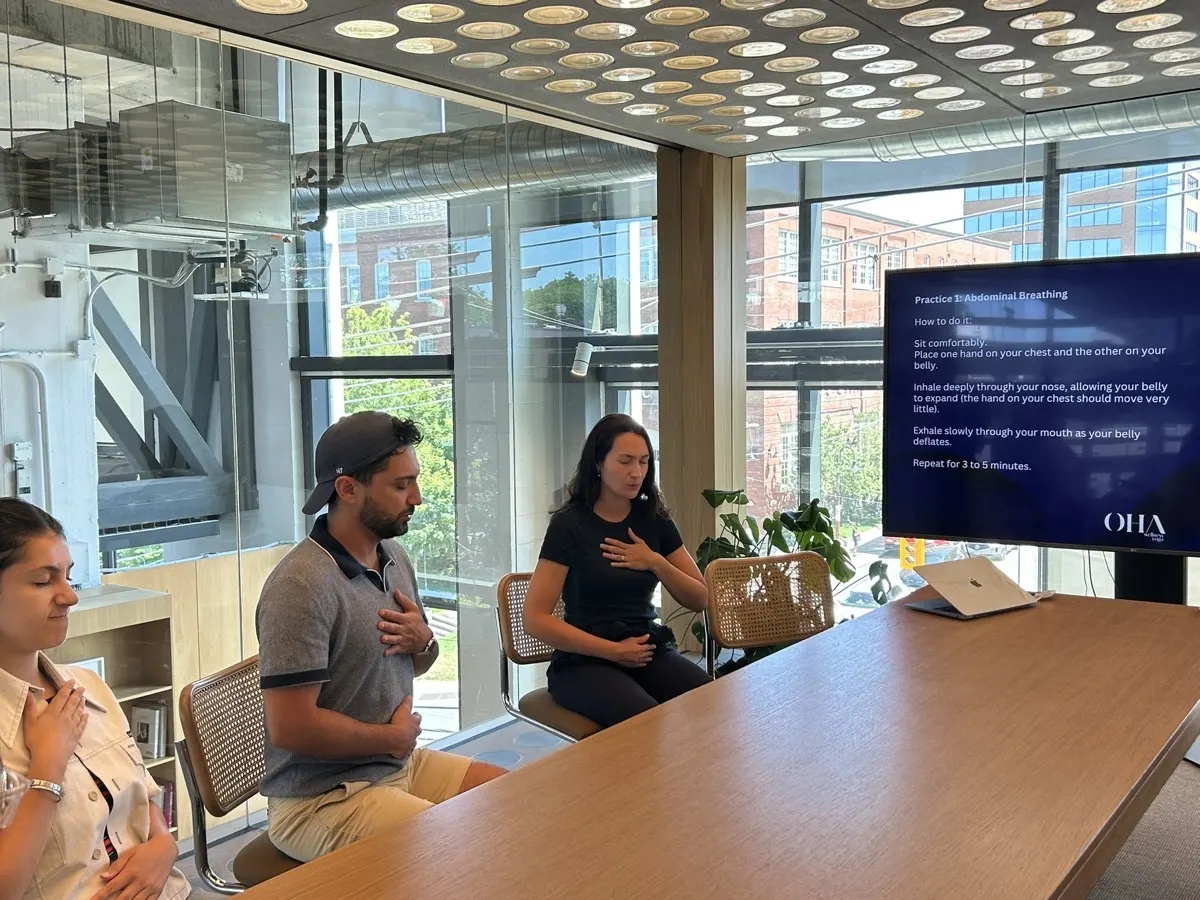
If you have an hour, in the office. Guided breathing for the whole team, seated where they are. A 30-minute chair yoga class, with no mats or change of clothes. A short stress workshop on recovering during the workday, 45 to 60 minutes, sized for a lunch hour. A problem-solving session on a real team irritant: everyone names what slows them down, the team picks one and agrees a first step. A skills swap, where three colleagues each teach something in ten minutes.
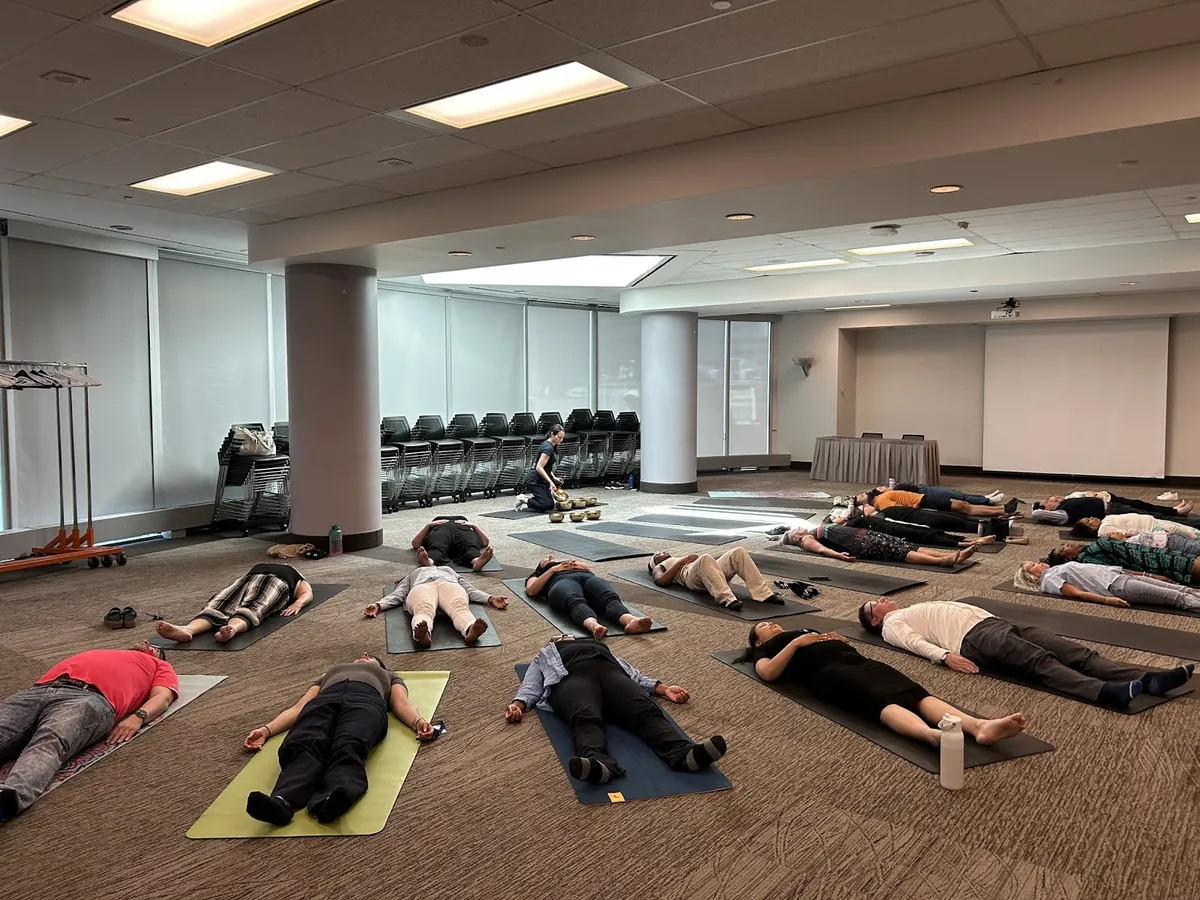
If you have a half day. A guided sound session, where the team lies back or sits while singing bowls fill the room, for 30 to 60 minutes with nothing to get right (see our page on a corporate sound bath). A 45 to 60 minute yoga class for the whole team, on mats or chairs, as our page on corporate yoga describes. A working session on how the team collaborates: how work is handed over, when it is fine to interrupt, what a meeting is for. A volunteer morning, with a choice of two causes.
If you have a full day. A wellness day that spreads sessions (breathing, yoga, a workshop, a sound session) across the day so people join between tasks. A two-part off-site, with a morning on priorities and a quiet afternoon. A volunteer day the team picks together. Other formats exist, such as cooking together, outdoor activities, escape rooms or virtual games; they suit some teams, as long as they meet the same five tests.
When should you organize team building?
When the team needs to come together, rather than on a fixed date. The most useful moments are a new manager or new member, two groups merging, the end of a heavy stretch, the return of a team scattered across remote work and the start of a season. For ideas that hold up week after week, see our post on wellness activities teams will attend.
Avoid the opposite: the activity dropped into the middle of a deadline, or announced as a reward when the work has been piling up. People then see it as one more obligation. If load is the real problem, fix part of it first, or make the activity the moment the team chooses what to take off its calendar.
Plan for people who are away too: a date set three weeks ahead, a short version for shift teams and invitations in both languages for bilingual workplaces.
How do you tell whether team building worked?
Ask participants a week later, not on the way out of the room. Three questions are enough: what stayed with you, what has changed in how we talk or share the work, and what would we keep or change next time?
Watch for concrete behaviour too: people who rarely spoke now writing to each other directly, a meeting where more voices are heard, an irritant named during the activity that has since been fixed. Attendance tells you almost nothing: it measures who was there, not what happened.
Look again at 90 days. If nothing has moved, the cause probably sits in what the team carries every day, not in the activity.
What OHA does about this
OHA leads shared wellness sessions in your office, in English or French, from 30 minutes to a full day, for groups of 10 to 50 people: see how to build a wellness day for your employees. The sessions are designed to help a team stop together; measuring what weighs on its capacity comes after. To talk about yours, contact OHA and get a quote within one business day.
Sources
- Small Group Research, Does Team Building Work?, 2009.