
How to prevent stress in the workplace when the cause is the work
An employer prevents stress at work by changing the conditions that produce it: workload, control, clarity, support and recognition. Individual tips and sessions help people cope and sit next to that work, not in place of it.
OHA Team, OHA Wellness
Published · Updated · Practice · 6 min
The short answer
Prevent stress at work by changing the work: measure where the load sits, fix one or two causes with managers, equip managers to spot stress, protect recovery time, then offer sessions people use.
On this page
To prevent stress in the workplace, an employer changes the conditions that produce it: how much work there is, how much say people have over it, how clear the role is and whether managers and colleagues back people up. The World Health Organization describes organizational interventions as those that assess, and then mitigate, modify or remove workplace risks to mental health, and lists excessive workloads or work pace, understaffing and lack of control over job design or workload among those risks.
Breathing breaks, resilience courses and stress tips help individuals cope, and they have a place. They work best next to changes to the work, so this post starts with the causes and then sets out, in the order an employer can act on them, how to prevent stress at work.
What causes stress at work?
Most work stress comes from how the work is set up. The Canadian Centre for Occupational Health and Safety (CCOHS) lists psychosocial risk factors that include workload management, involvement and influence, clear leadership and expectations, psychological and social support, and recognition and reward.
CCOHS says employees often describe a large workload as their biggest workplace stressor, and that it is not only the amount of work that counts but also whether people have the resources, such as time, equipment and support, to do it well. It links strain to high demands paired with little control, and to effort that goes unrewarded. In Quebec, the CNESST lists six factors under psychosocial risks at work: decision-making autonomy, workload, organizational justice, recognition at work, support at work and the different forms of violence.
CCOHS also notes that stress is not always harmful: it becomes a problem when a person cannot handle a situation and is overwhelmed. That is why the realistic answer to how to eliminate stress in the workplace is to remove the avoidable part, the strain built into the job. Our post on how to spot psychosocial hazards in the workplace shows how to look for it.
Why do individual stress tips fall short on their own?
They act on the person and leave the cause in place. CCOHS says control measures for psychosocial hazards should follow the same hierarchy as traditional health and safety principles, with interventions that address the source of the hazard prioritized, and it recommends prioritizing measures that can affect the whole organization over measures that focus only on what individuals do.
CCOHS places individual strategies to reduce stress and foster resiliency under promotion, and says prevention should be combined with it. Both belong in a plan. A breathing break helps a person get through an afternoon; it does not remove the approval steps that filled the morning.
You can often see the load before anyone names it. The signs show up in calendars, hand-offs and late-evening work, as the post on signs your team is overloaded describes. The check below puts the Five Loads side by side for you.
Five Loads quick check · 1 minute
Find the load consuming your team's capacity.
Five statements, about a minute. See all five loads side by side. Answer for your own week, or for the team you are worried about: how often is each of these true?
Statement 1 of 5
How do you prevent stress in the workplace?
Work in this order: find where the load sits, fix one or two work-design causes with the managers who own them, equip managers to spot and talk about stress, protect recovery time, then offer sessions people use. If you have asked how to prevent stress at work and got a list of personal habits, this is the list for the employer.
First, measure. Ask where the load sits before choosing a fix: in decisions, interruptions, emotional demands, coordination or administration. OHA's Five Loads are cognitive, decisional, emotional, relational and administrative, and naming the heaviest one tells you which cause to go after. Second, change the work. Remove one approval step, protect one block of focus time, clarify who decides what in a recurring project, or move a deadline that only exists out of habit. Choose one or two causes, give each an owner and a date.
Third, equip managers. WHO's fact sheet on mental health at work recommends manager training for mental health, to help managers recognize and respond to staff in emotional distress, build skills such as open communication and active listening, and understand how job stressors affect mental health. A manager who can ask about workload in a one-to-one is the earliest warning an organization has.
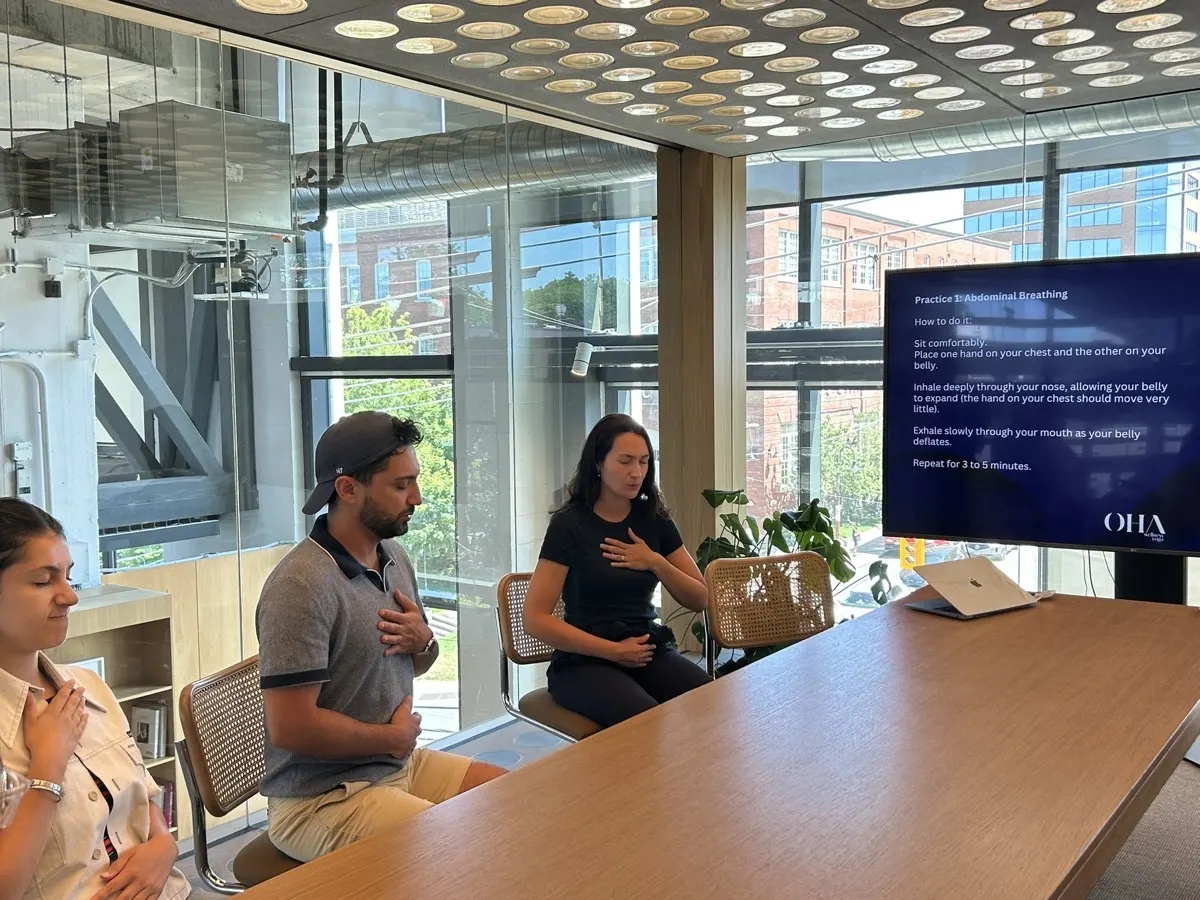
Fourth, protect recovery time: no-meeting blocks, a real lunch break, a limit on after-hours messages. Fifth, add sessions your people will use. A shared breathing practice at work, such as a breathing and meditation session at your office, or a stress management workshop for employees that gives managers and staff a shared vocabulary, works as the door into the rest of the plan, not as the plan.
What can an employer do this month?
Start small and keep it visible. Week one: ask each manager which one recurring task or meeting their team would drop first, and write the answers down. Week two: pick the cause that came up most often and name an owner. Week three: remove, merge or shorten it, and tell the team what changed. Week four: ask the same question again.
Alongside that, put one short manager conversation on the calendar: a 15-minute check-in with each direct report on what is on their plate, what slipped and one support that would help. Hold one shared session for the team on work time, so attending does not add to anyone's day. Keep a simple note of what you changed, so the next review has something to compare with.
These steps are designed to help you see which changes matter. They do not replace professional care for an employee who is struggling; point people to your employee assistance program or their own practitioner when that is what they need.
When is work stress a legal matter?
In Ontario, harassment duties apply. Under the Occupational Health and Safety Act, every employer must prepare and review at least annually a policy on workplace harassment (s. 32.0.1), and must develop and maintain a written program to put it into effect, in consultation with the joint health and safety committee or representative if there is one (s. 32.0.6). The employer must also ensure that an investigation appropriate in the circumstances is conducted into incidents and complaints (s. 32.0.7).
In Quebec, the CNESST's list of psychosocial risk factors, above, is how it frames what to look for.
This is information, not legal advice. For a specific situation, call an employment lawyer, the Ontario Ministry of Labour or the CNESST.
What OHA does about this
OHA starts with a Capacity Diagnostic, built to measure where the Five Loads sit across a team. We then work with managers on one or two of them in a 90-day Capacity Circle™, designed to help, and measure again. Wellness sessions led by our team, in your own office, give people a real pause alongside that work. Send us the team you would start with and ask for a quote within one business day. See stress management for teams at OHA.
Sources
- World Health Organization, Mental health at work, 15 September 2026 (fact sheet).
- CCOHS, Mental Health - Psychosocial Risk Factors in the Workplace, 2023 (fact sheet last revised 18 September 2023).
- CNESST, Facteurs de risques psychosociaux liés au travail, 2026 (in French; page read 18 November 2026).
- CCOHS, Psychological Health and Safety Program - Controlling Psychosocial Hazards, 2022 (published 20 May 2022).
- Ontario, Understand the law on workplace violence and harassment, 2026 (workplace harassment section of the guide; page read 18 November 2026).