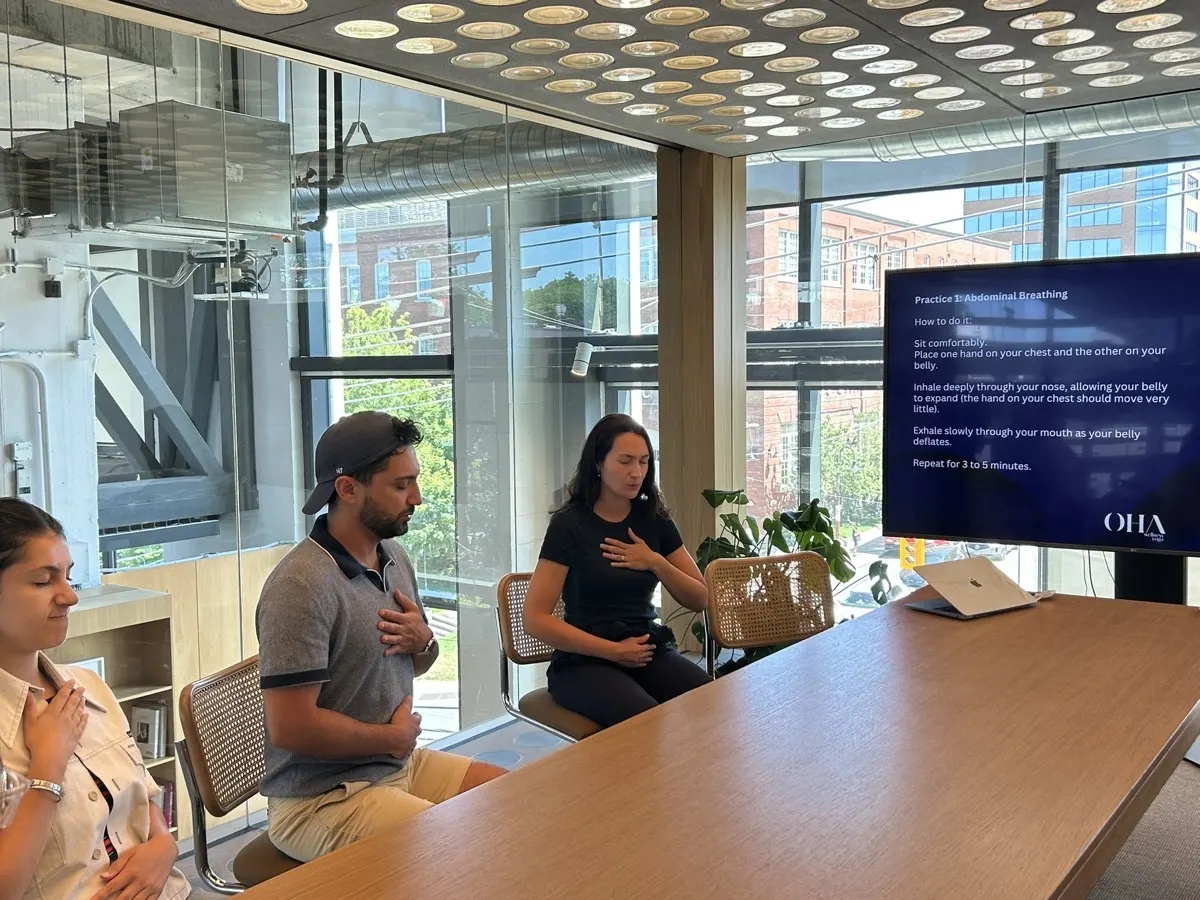
Mental health first aid training and the work around it
Mental Health First Aid teaches people to recognize declining mental health and respond. What the courses cover as the MHCC publishes them, what the research says, and what a manager still needs: workload, team design and recovery.
OHA Team, OHA Wellness
Published · Updated · Leadership · 6 min

The short answer
Mental Health First Aid teaches people to recognize changes in mental health, respond supportively and take practical steps in a decline or crisis, and a 2018 review of controlled trials supports its effect on knowledge, confidence and intention to help. It does not change the workload, team design or recovery time a manager works within.
On this page
Mental health first aid training teaches participants to recognize changes in someone's mental health, respond supportively and take practical steps when mental health is declining or in crisis. In Canada it is offered through Opening Minds, the social enterprise of the Mental Health Commission of Canada (MHCC), and a 2018 review of controlled trials supports its effect on knowledge, confidence and the intention to help.
This post sets out what the courses cover as Opening Minds publishes them, what the research says they are good for, and what a manager still needs after the course: a workload that leaves room to use it, a team designed to carry it and time to recover. It is written for HR leads who are buying training for managers and want it to hold.
What does mental health first aid training cover?
Opening Minds describes Mental Health First Aid (MHFA) as giving participants the knowledge, skills and attitudes to recognize changes in mental health, respond supportively and apply practical actions for declining mental health and crisis situations. It also describes the course as building confidence, reducing stigma and strengthening participants' own mental health, and presents it as a course for everyone rather than for one role.
The core of the course is a five-part framework called ALGES. The first aider approaches the person, assesses for a crisis and offers immediate help if needed; listens without judgment; gives reassurance and information; encourages professional help and other supports, such as family, friends or self-care; and looks after their own mental health to manage the emotional impact of helping. The modules around it cover what mental health is and how stigma works, practice with scenarios of declining mental health, self-care for first aiders and crisis situations, including suicide risk and psychosis. Participants also learn the risks and limitations of diagnostic labels.
Which Mental Health First Aid course fits a team of managers?
Opening Minds lists three types. MHFA Certification is 12 hours of instruction, spread over two to four days, fully facilitated in person or virtually, and leads to an official certification after assessment; it adds coverage of mental health disorders and their prevalence and more scenario-based exercises. MHFA Essentials is a streamlined course of 6 hours of instruction spread over one or two days and does not lead to certification. Community-based courses are built with the communities they serve.
For a cohort of managers, Opening Minds offers private group training, with custom pricing, for groups of eight or more, and says courses are also offered by independent facilitators who set their own rates. The adaptations listed on the Essentials page are for youth, older adults, veterans and the Deaf community. The course pages do not describe a course written for managers, although group training can be arranged for a workplace.
What is Mental Health First Aid training good for?
It is good for what it sets out to do. A 2018 systematic review and meta-analysis of 18 trials with 5,936 participants found that MHFA training improved mental health first aid knowledge, recognition of mental disorders and beliefs about effective treatments, with small reductions in stigma. It also improved confidence in helping a person with a mental health problem and intentions to provide first aid, and there were small improvements in the amount of help provided at follow-up. The authors conclude that it improves mental health literacy and appropriate support up to 6 months after training, and report that effects up to 12 months, and changes in the quality of the help offered, are unclear.
The World Health Organization recommends training for managers in particular. Its fact sheet on mental health at work, dated 15 September 2026, recommends manager training that helps managers recognize and respond to supervisees experiencing emotional distress, builds skills such as open communication and active listening, and fosters a better understanding of how job stressors affect mental health. This post assumes you keep the course.
What does mental health first aid training leave out for a manager?
It prepares a manager to help a person; the course pages say nothing about the work around that person. The modules on the course pages run from definitions and stigma through ALGES, scenarios, self-care and crisis. No module title mentions workload or how a team is organized; the self-care module is for first aiders. In OHA's reading, those are the three things a manager needs once the conversation has happened.
Workload comes first. Statistics Canada's Canadian Survey on Working Conditions, collected in 2024-2025, found that half (50.2%) of workers in management frequently worked to tight deadlines, and that 34.6% of managers did unpaid work in their free time several times a month or more to meet job demands. A manager who has learned to notice distress still decides which work moves when someone is struggling. The WHO fact sheet recommends organizational interventions that directly target working conditions as the way to prevent work-related mental health conditions, and lists manager training separately.
Team design is next: who covers when someone is off, which approvals sit with a manager and which decisions belong to the person who knows the work. Recovery is last. The course includes a module on self-care for first aiders and a goal of identifying personal self-care strategies; whether a manager's calendar leaves room for them is a design question, taken up in our post on recovery as a leadership skill. In OHA's framework these show up across the Five Loads. The check below takes about a minute and uses five of the ten statements in OHA's capacity self-portrait, one for each load, led by a cognitive one.
Five Loads quick check · 1 minute
Find the load consuming your team's capacity.
Five statements, about a minute. See all five loads side by side. Think of a manager you have trained or are about to, or your own last working week: how often is each of these true?
Statement 1 of 5
What should HR add beside the course?
Keep the course and add a team-level read. Before the next cohort goes through MHFA, measure the five loads on the managers' teams and on the managers themselves, pick the heaviest and change one thing in the work: an approval step, a standing meeting, a hand-off. Repeat the same measure about 90 days after the course. Our post on mental health training for managers and what changed in their load sets out how to do that around a cohort.
Then ask three questions about any manager training, including this one. What will a trained manager do when someone tells them the workload is the problem? Who can change it? How will you know it changed? A course can answer the first. The second and third belong to the organization.
What OHA does about this
OHA works on the conditions around the course. Its leadership development program for managers under pressure is designed to measure the Five Loads on a manager's team, show which weighs most and act on it in a 90-day Capacity Circle™, with the same measurement repeated at day 90. The page sets out what the program covers.
Sources
- Mental Health Commission of Canada, Courses, 2026 (page consulted 28 October 2026).
- Mental Health Commission of Canada, Opening Minds, Mental Health First Aid, 2026 (page consulted 28 October 2026).
- Mental Health Commission of Canada, Opening Minds, Mental Health First Aid - Essentials, 2026 (page consulted 28 October 2026).
- Mental Health Commission of Canada, Opening Minds, Mental Health First Aid - Certification, 2026 (page consulted 28 October 2026).
- PLOS ONE, Systematic review and meta-analysis of Mental Health First Aid training..., 2018 (Morgan, Ross and Reavley, 18 trials).
- World Health Organization, Mental health at work, 15 September 2026.
- Statistics Canada, Canadian Survey on Working Conditions, 2024-2025, The Daily, 16 January 2026.