Employee wellbeing strategy: the plan that changes the work
An employee wellbeing strategy finds where the work wears people down, changes one or two of those things with managers and checks at 90 days whether anything moved. A calendar of activities is not one.
OHA Team, OHA Wellness
Published · Updated · Leadership · 5 min
The short answer
Measure where load sits for one population, act on one or two loads with the managers who own the work, and remeasure at day 90. Put the goal, population, measures, owners, budget line and review date on one page.
On this page
An employee wellbeing strategy is a plan to find out where the work is wearing people down, change one or two of those things with managers, and check at 90 days whether anything moved. A calendar of activities is not a strategy, because it schedules support without saying what it is meant to change.
This post gives HR and executive leaders the 90-day shape, the contents of a one-page strategy and a way to make the case for the budget. It is the Capacity Circle™ in plain words: the method OHA built to measure capacity, act on the load that weighs most and measure again.
Why do most wellbeing strategies stay a calendar?
Because a calendar is easy to buy and easy to report. A list of sessions, a speaker series and a benefits reminder can be approved in a week and counted by attendance, while a change to the work needs someone to own it. The World Health Organization says 12 billion working days are lost every year to depression and anxiety, at a cost of US$1 trillion a year in lost productivity. A problem of that size is a reason to aim at the cause, not only at the response. That is why the first question to put to any proposed program is what it changes in the work itself.
The research on job-stress interventions points the same way. A 2007 systematic review of 90 evaluations found that interventions aimed only at individuals improved outcomes for those individuals but generally did not show favourable effects at the organizational level, while interventions aimed at the organization benefited both.
What does a strategy that misses the load cost?
Canadian figures put it in the billions, and your own range is the one that matters to your CFO. The Mental Health Commission of Canada's estimate of what mental health problems cost Canadian businesses was more than $6 billion in 2011, from absenteeism, presenteeism and turnover. The commission also reports that these problems account for about 30% of short- and long-term disability claims. The $6 billion figure is for 2011, and the commission notes the report was published in 2013 and its data may be out of date, so treat both figures as an order of magnitude.
Use your own headcount and salary to size the problem for your organization. A strategy needs a number that belongs to your organization: what absence, turnover and unfilled hours cost you, set beside what the plan will cost. Put that range in the strategy's budget line, so the review at day 90 compares like with like.
Burnout cost calculator · 2 minutes
Put a number on lost capacity.
Your headcount, salaries and absence data give a yearly cost range, with every assumption shown. Enter your headcount, average salary and, if you know them, absence days and departures. The result is a range, with the assumptions beside it.
Step 1 of 2 · Your organization
What are the three moves of a 90-day strategy?
Measure where load sits, act on one or two loads with managers, and remeasure at day 90. Measure first: a baseline of the five loads (cognitive, decisional, emotional, relational and administrative) for one population, read by team and role. OHA's Capacity Diagnostic is built to do this in three to four weeks, and our post on what the Capacity Diagnostic measures explains what it reads.
Then act. Pick the load that dominates and change something concrete in the work with the managers who own it: remove an approval step, clarify who decides, protect a block of time, split a role that has too many hand-offs. The World Health Organization describes organizational interventions as measures that assess, and then mitigate, modify or remove workplace risks to mental health. That is this move.
Last, remeasure. Run the same measure at day 90, compare it with your own day-one baseline and report what moved and what did not. The cycle then restarts at the new baseline, so the strategy is a loop rather than a launch.
What should an employee wellbeing strategy include?
One page with six entries: the goal, the population, the measures, the owners, the budget line and the review date. State the goal as a change in the work, such as fewer decisions waiting on approval, not as a feeling. Name one population at a time: a function, a site or a manager cohort. Choose the measure before you start, and read one operational number you already track, such as absence or turnover, beside it.
Name an executive owner and a manager for each action, and put the budget line against real items: the diagnostic, manager time, the sessions. Fix the review date in the calendar before day one. Our post on whether to measure capacity or wellbeing explains why the measure should be the load people carry, not their mood on the day.
Where do wellness sessions fit, and how do you make the case?
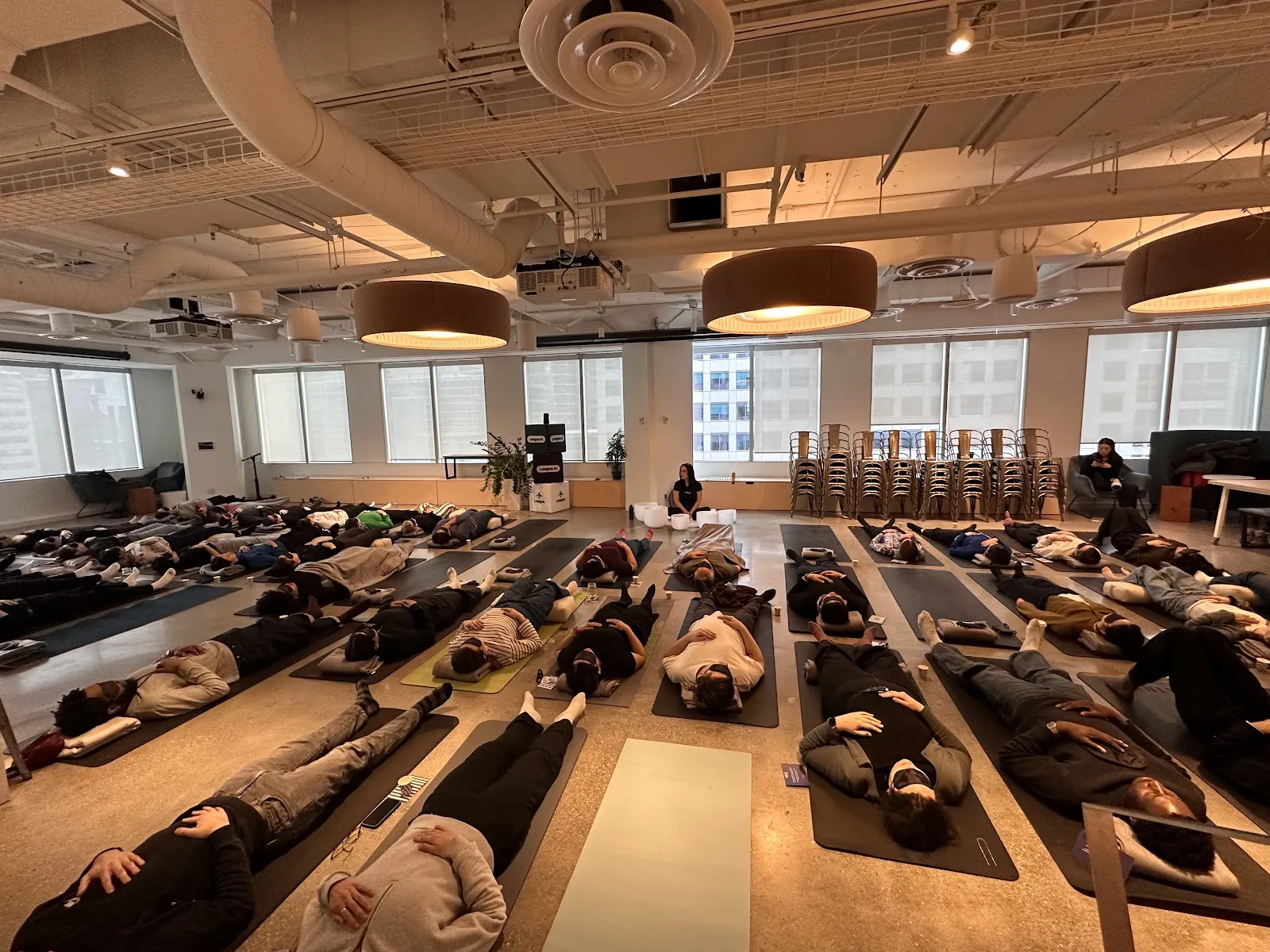
Sessions are the door, not the plan. A wellness day or a single session gives a team a real pause and is the part people feel at once, so place one early in the 90 days while the measurement and the change to the work take their course. See wellness days for employees for the formats.
Make the case to leadership with three things: your own cost range, a baseline that shows where the load sits and a day-90 comparison. A wellness strategy that ends in a comparison can be defended in a budget meeting; a participation rate cannot say what changed. The Capacity Diagnostic is where the baseline comes from.
What OHA does about this
OHA's sustainable human performance work is this strategy run across a year: a Capacity Diagnostic to set the baseline, 90-day cycles with managers and teams, and a day-90 remeasure built to measure what moved. It is designed to help leaders decide where the work needs to change, and a wellness session can be the first step. See how OHA works on sustainable human performance.
Sources
- World Health Organization, Mental health at work, fact sheet, 15 September 2026.
- International Journal of Occupational and Environmental Health, A systematic review of the job-stress intervention evaluation literature..., 2007 (literature 1990 to 2005).
- Mental Health Commission of Canada, Making the case for investing in mental health in Canada, September 2013 ($6 billion figure: 2011 data).